
Sure, you might finally get the hang of it after building your virtual fishing skills for hours, but who wants to lose for that long? On the easiest level, in the simplest fishing hole, you will find that catching a fish in Reel Fishing isn't anything like real life. You have a 95 percent chance of losing either the fish, the bait, the hook, or (most likely) all three.  I really couldn't stand to watch someone play this for the first time; my own experience was bad enough.
Void. qtfindobjchild ( QObject. parent, const char. Contoh perjanjian sewa menyewa rumah pdf merge file. type, const char. name ) Description. The QObject class is the base class of all Qt objects. QObject is the heart of the Qt object model. The central feature in this model is a very powerful mechanism for seamless object communication called signals and slots.
First, we need a base class which make all of it's subclass serializable.
SerializableClass.h
#ifndef SerializableClass_H_
#define SerializableClass_H_
#include <qt4/QtCore/qobject.h>
#include <qt4/QtCore/qdatastream.h>
class SerializableClass : public QObject
{
Q_OBJECT
public:
explicit SerializableClass(QObject *parent = 0);
};
QDataStream &operator<<(QDataStream &ds, const SerializableClass &obj);
QDataStream &operator>>(QDataStream &ds, SerializableClass &obj) ;
#endif /* SerializableClass_H_ */
#include 'SerializableClass.h'
#include <qt4/Qt/qvariant.h>
#include <qt4/QtCore/qmetaobject.h>
SerializableClass::SerializableClass(QObject *parent) :
QObject(parent)
{
}
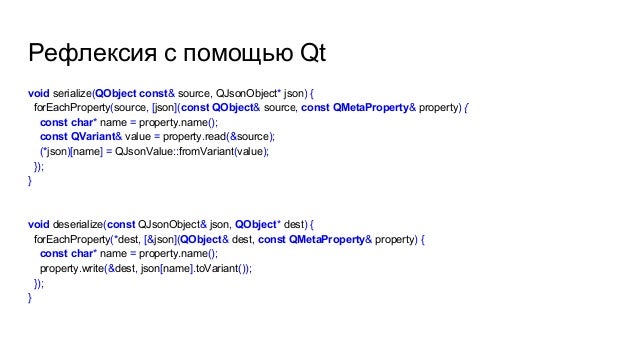
QDataStream &operator<<(QDataStream &ds, const SerializableClass &obj) {
for(int i=0; i<obj.metaObject()->propertyCount(); ++i)
{
if(obj.metaObject()->property(i).isStored(&obj))
{
ds << obj.metaObject()->property(i).read(&obj);
}
}
return ds;
}
QDataStream &operator>>(QDataStream &ds, SerializableClass &obj) {
QVariant var;
for(int i=0; i<obj.metaObject()->propertyCount(); ++i)
{
if(obj.metaObject()->property(i).isStored(&obj))
{
ds >> var;
obj.metaObject()->property(i).write(&obj, var);
}
}
return ds;
}
#ifndef STUDENT_H_
#define STUDENT_H_
#include 'SerializableClass.h'
class Student : public SerializableClass
{
Q_OBJECT
Q_PROPERTY(int id READ getId WRITE setId)
Q_PROPERTY(QString Name READ getName WRITE setName)
public:
Student();
int getId() const { return id; }
void setId(int newId) { id = newId; }
QString getName() const { return Name; }
void setName(const QString &newName) { Name = newName; }
private:
int id;
QString Name;
};
#endif /* STUDENT_H_ */
#include 'Student.h'
Student::Student()
{
}
Q_DECL_EXPORT int main(int argc, char **argv)
{
Student G;
Student G2;
G.setId(30);
G.setName('pervez');
qDebug()<<G.getId()<<G.getName();
QByteArray byteArray;
QDataStream out(&byteArray, QIODevice::WriteOnly);
out <<G;
qDebug()<<G2.getId()<<G2.getName();
QDataStream in(byteArray);
in >> G2;
qDebug()<<G2.getId()<<G2.getName();
Application app(argc, argv);
new ApplicationUI(&app);
return Application::exec();
}