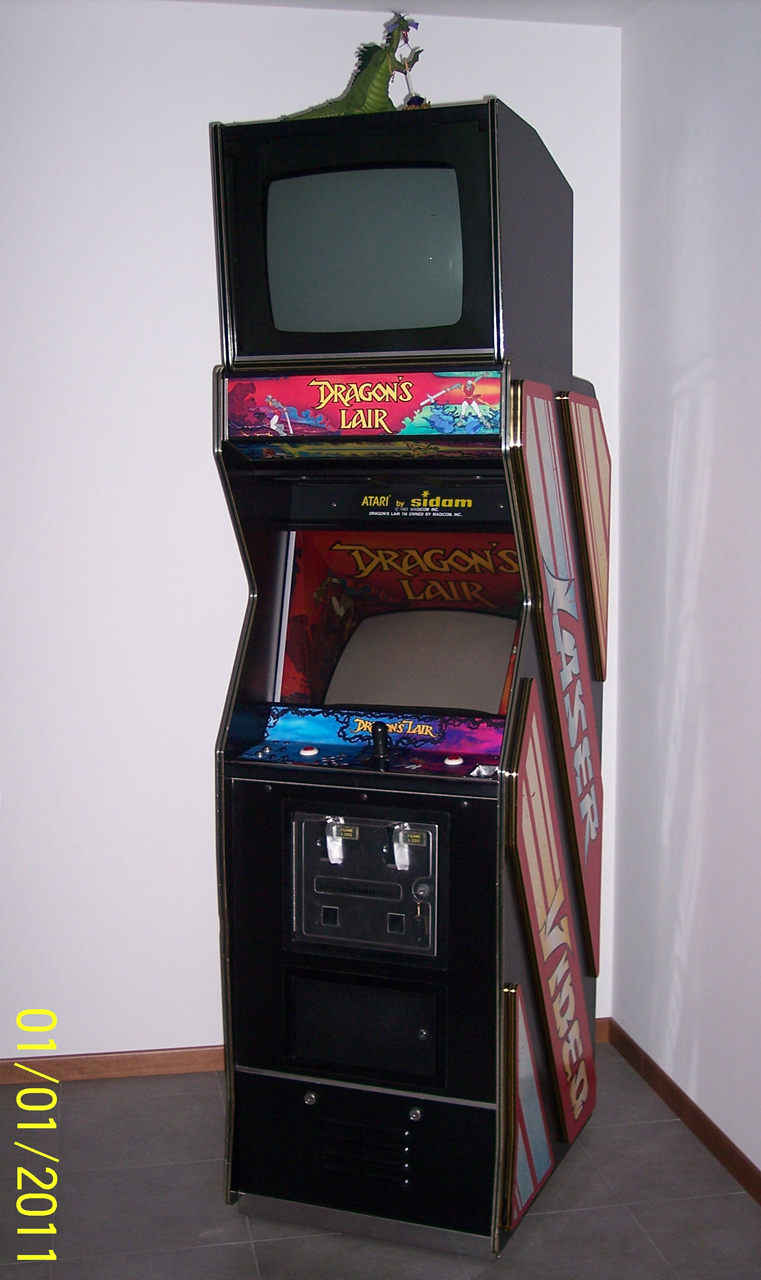
Any attempt at true emulation would have to take this into account. Digital Leisure has. Actually this game used not a laserdisc but a CED videodisc.
Because these games used laserdiscs to play video footage, any attempt to emulate the original would completely lack the video without a large movie file - the machines rely on the frame number of the CAV laserdiscs to find the correct video to display, and there can be over 60000 frames (individual images that play to create the video, or pause for a still screen) on a LD. Any attempt at true emulation would have to take this into account. Digital Leisure has released Dragon's Lair 1, 2, Space Ace, and Hologram Time Traveler on DVD and DVD-ROM. For information on laserdisc games in general, visit the Dragon's Lair Project and Atari Headquarters arcade section. For those very motivated, you can connect certain model LD players (or download huge MPEG dumps of the video) to your computer and emulate some of these games using the Daphne emulator.
Dragon's Lair (Cinematronics, 83)
Pictures taken from MAME WIP page.
Astron Belt (Midway/Sega, 83)
Galaxy Ranger / Star Blazer (Midway/Sega, 83)
Laser Grand Prix (Taito, 83)
Space Ace (Cinematronics, 83)
Quarterhorse (Electro Sport, 83)
Bega's Battle (Data East, 83)
Star Rider (Williams, 83)
Pictures taken from Arcade Flyer Archive
Pitchman (Stern [prototype], 83)
Possibly only one copy in existence.
Albegas / Cybernaut (Sega/Bally/Midway [ever finished/released?], 83)
The disc is known (I actually bought it from a laserdisc rental store in Oakland California) but no board has been found.
GP World (Sega, 84)
Pictures taken from Arcade Flyer Archive
NFL Football (Midway, 84)
Actually this game used not a laserdisc but a CED videodisc. This format differs from LD in that the discs stay in plastic cases (like minidiscs but a lot bigger) and they don't play with a laser. The CED player physically contacts the disc like a phonograph record.
Road Runner (Atari [prototype], 84)
Snapshots from some CA Extreme YouTube videos.
This version of the game plays almost exactly like the version later released by Atari, but with a background streamed off the laserdisc, and animated cutscenes from the cartoon. More info can be found at Dragon's Lair Project.
Battlestar Galactica (Atari [prototype], 84)
Snapshots of the YouTube video.
YouTube video shows footage of this unfinished Firefox conversion 'available this summer'. The jumpy format of the video suggests that it was a playable demo, though. It also mentions new features of 'increased flying', 'more action', 'visual realism', 'and introducing.. TURBO BOOST'. Near the end is a frame of signatures. More information can be found at, of course, Dragon's Lair Project.
Casino Strip (Status, 84)
Thunder Storm FX (Data East, 84)
Japanese version of Cobra Command, in MAME. I'm not sure if the not-working Data East versions of Cobra Command are actually Thunder Storm, however without the Japanese laserdisc it's a moot point anyway.
Road Blaster FX (Data East, 85)
Road Avenger is the name of the version made for home systems such as the Sega CD. A version for the Pioneer LaserActive unit was also made called Road Prosecutor.
Jamon jamon google drive.
Max Mile (Konami [ever finished/released?], 84)
Ninja Hayate (Taito, 84)
Thayer's Quest (RDI Video Systems, 83)
Super Don Quixote (Universal, 84)
Badlands (Konami, 84)
Cosmos Circuit (Taito, 84)
Goal to Go (Stern, 83)
Gold Medal with Bruce Jenner (Stern [prototype], 84)
Supposedly only two copies in existence.
Esh's Aurunmilla (Funai/Gakken, 83)
Interstellar Laser Fantasy (Funai/Gakken, 83)
Atomic Castle (Stern/Sega/Bally/Midway, 83)
Possibly only one copy in existence.
Top Gear (Universal [prototype?], 84)
Pictures from flyer.
Flyer describes the racing game as having four courses: Present, Near Future, Future, and Space, with 2 minutes per course, however flyer for Top Gear 2 appears to describe it as only having the above two courses 'City' and 'Circuit'. Outside of trade show pictures and flyers, I don't believe there is any other trace of this game to be found in the US at least.
Top Gear 2 (Universal [prototype?], 85)
Picture from flyer.
The flyer describes this as a 'volume two' expansion pack of more courses for the Top Gear cabinet: 'Space Course' and 'Park Course'. The flyer's picture of the cabinet also appears to have a working game showing the title screen.
Captain Zapp (Universal [prototype?], 85)
Pictures from flyer.
From the pictures, appears to be very similar to Super Don Quixote.
Time Gal (Taito, 85)
Space Battleship Yamato (Taito, 85)
Freedom Fighter (Malibu Grand Prix / Millennium Game Products, 87)
The Spectre Files (Midway [prototype, laserdisc], ~87)
Info from Game Refuge:
A film adaptation of an original interactive text adventure designed for an Arcade Laser disc game that was scrapped before the game's completion.
Galaxian³: Project Dragoon (Namco, 90)
Galaxian³ was a theatrical 6-player polygon game in the same vein as the one-player Starblade. You aim the crosshairs at the enemy and fire away.. The background, though appearing to be computer generated like Starblade is actually played off a set of laserdiscs.
A Japanese version of Galaxian³ exists for the Playstation.. including the vertical black bar in the middle of the screen!
Attack of the Zolgear (Namco, 94)
Similar game to Galaxian³ (theater setting) but you could choose your path at certain parts of the game. According to Styx Zolgear was a conversion kit for Galaxian³, with a different romset and laserdiscs.
Mad Dog McCree (American Laser Games, 90)
Who Shot Johnny Rock? (American Laser Games, 91)
Mad Dog II: The Lost Gold (American Laser Games, 92)
Space Pirates (American Laser Games, 92)
Gallagher's Gallery (American Laser Games, 92)
Crime Patrol (American Laser Games, 93)
Crime Patrol 2: Drug Wars (American Laser Games, 93)
The Last Bounty Hunter (American Laser Games, 94)
Fast Draw Showdown (American Laser Games, 95)
(Hologram) Time Traveler (Virtual Image Productions / Sega, 91)
Dragon's Lair II: Time Warp (Leland, 91)
The US version 3.16 of Dragon's Lair II is a Most Wanted ROM, if it exists.
Shootout at Old Tucson (American Laser Games, 93)
Marbella Vice (Picmatic SA, 94)
Pictures taken from Arcade Flyer Archive
Spanish game that uses light guns. YouTube also has a video of some of the footage.
Cops (Atari, 94)
Zorton Brothers (Los Justicieros) (Web Picmatic, 93)
Laserdisc needs to be dumped.
Tierras Salvajes (Picmatic SA, 95?)
Picture from Picmatic webpage.
Western lightgun game.
LD Mahjong #4 Shabon-Dama (Nichibutsu, 9?)
Platoon (Nova?, 9?)
Laserdisc needs to be dumped.
Back
A laserdisc video game is an arcade game that uses pre-recorded video (either live-action or animation) played from a laserdisc, either as the entirety of the graphics, or as part of the graphics.
History[editedit source]
The first laserdisc video game was Sega's Astron Belt, an early third-personspace combatrail shooter featuring live-action full-motion video footage (largely borrowed from a Japanese science fiction film) over which the player/enemy ships and laser fire are superimposed.[1][2] Developed in 1982,[3] it was first unveiled at the 1982 AMOA show in Chicago and released the following year. However, the game that popularized the genre in the United States was Dragon's Lair, animated by Don Bluth and released by Cinematronics shortly after.[2] Around the same time, the laserdisc game Bega's Battle was also released, followed by Cliff Hanger.
One of the earliest laserdisc video games was Dragon's Lair. It contained animated scenes, much like a cartoon. The scenes would be played back and at certain points during playback the player would have to press a specific direction on the joystick or the button to advance the game to the next scene. For instance, a scene begins with the hero falling through a hole in a drawbridge and being attacked by tentacles. If the player presses the button at this point, the hero fends off the tentacles with his sword, and pulls himself back up out of the hole. If the player fails to press the sword button at the right time, or instead presses a direction on the joystick, the hero is attacked by the tentacles and crushed.
Despite the high cost of the animation, a deluge of similar laserdisc video games followed Dragon's Lair because of its immense popularity. To cut costs, several companies simply hacked together scenes from obscure Japanese anime, creating games like Cliff Hanger (from Lupin III: Castle of Cagliostro and Lupin III: Mystery of Mamo) and Bega's Battle (from Harmagedon). Other arcade laserdisc games include Time Traveler, Badlands and Space Ace.
Later laserdisc video games integrated more and more computer graphics with the pre-recorded video. M.A.C.H. 3 and Cube Quest, for instance, were vertical scrolling shooters that used the laserdisc video for the background and computer graphics for the ships. The Firefox arcade game included a Philips Laserdisc player to combine live action video and sound from the Firefox film with computer generated graphics and sound. The game used a special CAV Laserdisc containing multiple storylines stored in very short, interleaved segments on the disc. The player would seek the short distance to the next segment of a storyline during the vertical retrace interval by adjusting the tracking mirror, allowing perfectly continuous video even as the player switched storylines under control of the game's computer. This method of seeking was noted for being extremely strenuous on the player and frequently led to the machines breaking, slightly hindering the appeal of laserdisc arcade games.
In the 1990s, American Laser Games produced a wide variety of live-actionlight gun laserdisc video games, which played much like the early laserdisc games, but used a light gun instead of a joystick to affect the action.
See also[editedit source]
References[editedit source]
- ↑Laserdisc video game at Allgame via the Wayback Machine
- ↑ 2.02.1ASTRON BELT. Atari HQ. Retrieved on 2011-03-25
- ↑Mark Isaacson (2002). The History of Sega: From Service Games to Master Systems. Retrieved on 2011-03-25
External links[editedit source]
- 'Laser Daze', from The Dot Eaters: Videogame History 101